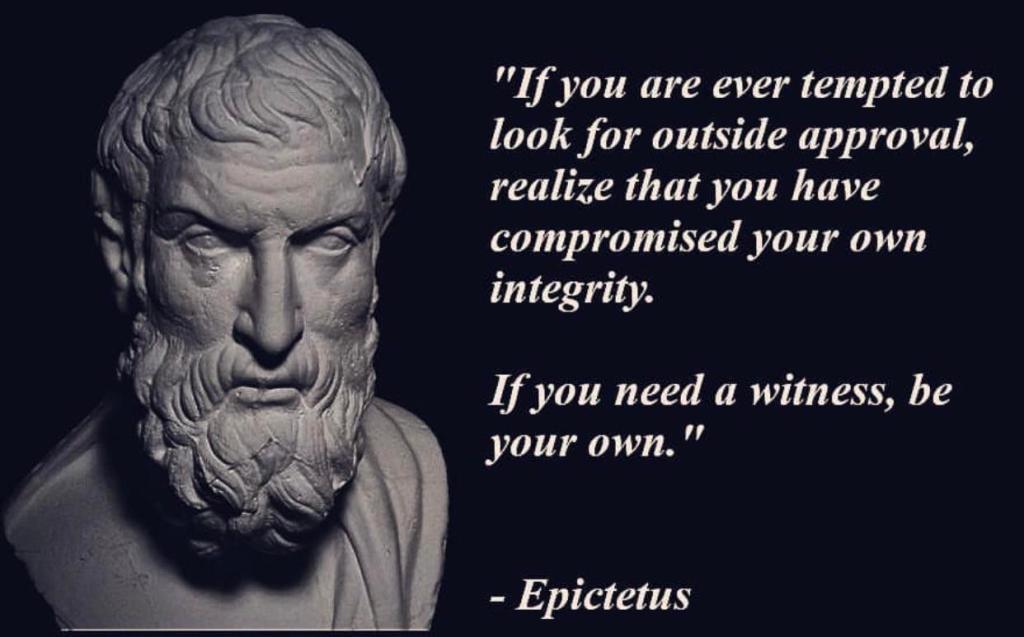
The scowling fellow above is, as the inscription tells you, an ancient philosopher named Epictetus. Eppy, as his friends called him (well, maybe not), was a slave in a Roman household who was very wise and very learned. He developed rules for living which is a philosophy now known as Stoicism.
Stoicism comes down to this basic belief: There are only two things in this life you can control, what you do and what you think. Everything else is beyond your control. So if you live a good life, do your best in everything you do, remain honest and treat others with respect, when you die, no matter what you’ve accomplished or failed at, you have lived the best life you could. So why worry about anything else?
I became enamored with Stoicism when I found a little book in Borders (remember that store?) called “The Good Life Handbook.” I have always been a sucker for someone else telling me what I’m doing wrong. The book was a retelling of the philosophy of ol’ Eppy. It made a lot of sense to me.
So much so that I found an old Classics Library translation of the original book by Epictetus (as written by someone else). Now, usually when I try to read philosophical writing, I fall asleep. I’m not being facetious. I have a hard time grappling with the dense prose of most philosophy texts. For instance, I’ve been plowing very, very slowly through Plato’s Republic for the last 25 years. I’m about halfway through. So far as I can tell, Socrates didn’t like democracy much and proposed a society where everyone knew their place. He might have been a smart man but, in my humble opinion, he didn’t know much about the ability of human beings to invent themselves in order to live the way they wanted.
But I digress. I found Epictetus to be very readable, very reasonable, very in tune with the way humans live their lives. Unlike the cliche of Stoicism, which would have you believe that Stoics ignore their emotions and try to live a strict, dull live, Epictetus talked about how to avoid excess emotions which destroy lives.
The example most people who have heard of Stoicism think of is in Julius Caesar, the Shakespeare play, wherein Brutus is told of the death of his wife and children and turns nary a hair. The idea is that, as a Stoic, he is unaffected by the deaths of his family.
No, Epictetus didn’t teach that. He said go ahead and have your feelings. Mourn and grieve. That’s natural. But then don’t continue to mourn and grieve to the point that you can’t do anything else. Understand that the deceased loved one had to die sometime, and that there’s nothing you can do about their death. Give them their due in grief. Then move on.
When I started to try to live as a Stoic, I took the teaching about fame and fortune to heart. It is encapsulated in the quote above. Don’t judge yourself on how others think of you. Don’t measure yourself by whether you’re rich or famous. Be your own witness.
In the writing game, this isn’t easy. We writers have come to judge ourselves on whether we’ve been published. When I won the Black Orchid Novella Award 2 1/2 years ago, I thought I was on my way to becoming a professional writer. I had a good character, original, not like anyone else out there. I had some good stories. All I had to do was write a good novel.
I still think that. As I said in an earlier post, I wrote a novel, but that novel was deeply flawed. A good character is not enough. So I am rewriting it, with the idea that at the end I may still not have a good novel. But I’ll keep writing novels about Minerva until I write a good one. I know I can do it. I’ve done it before. I know I’m a good writer. I know this, not only because I’ve had seven Minerva stories published, but because I have improved over the years. I read old stuff I’ve written and can see the progress. Whether I ever get a novel put out there by another publisher doesn’t change the quality of my writing. Heaven knows, I’ve read some awful books by other writers that were cheerfully published by big publishing houses. Books which I will not name here.
I continue to suffer rejections. Recently a fantasy magazine rejected one of my Dragon Wife stories, telling me that it was funny and original and that the ending came together but they didn’t take it because “the beginning wasn’t as strong.” As regular readers of this blog know, I get a lot of these “you came really close” rejections. In the beginning it was thrilling to know that I was on the brink. But I’ve been on the brink for years, now. Like the golf ball on the edge of the hole, I wonder whether anything will ever come along to drop me in.
Ah, but I need to remember ol’ Epictetus. I write because I love writing. If I didn’t love writing I would have quit when I was 25. Here I am at 64 still knocking at the door.
Maybe someone will answer. Maybe they won’t. The important thing is that I keep knocking.
Because, hey, I didn’t choose the Stoic life, the Stoic life chose me.
 Mark Bruce, Writer