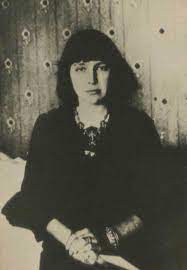
If you want to humble yourself, read the journals of great poets who had tragic and impossibly difficult lives. Like the lady pictured above, Marina Tsvataeva.
Of course she’s Russian. As someone once said, the Russians take their poetry so seriously that the government shoots poets. Or in Marina’s case, they starved her out so that she had to hang herself to make sure her daughter could be taken care of.
Marina grew up in a middle class family before the Russian Revolution. She was a precocious child, publishing her first book of poetry when she was 17. The other poets celebrated and feted her in that pre-Bolshevik period. She married another poet at an early age and had two daughters and a son.
But her husband was a White Russian officer, so when the Communists took over the government, she couldn’t get a word of her poetry published.
You think that stopped her? No. The woman continued to write, escaping to Paris and publishing a number of brilliant works.
What is puzzling about her is that she chose to return to the USSR even though she knew it meant poverty and death. Ah, those Russians. They can’t stay away from the Mother Land.
So when you read her journals of 1921-1924, you read wonderful and aching passages about her riding on trains talking to soldiers, about selling her old possessions to buy bread, about the hunger of her children, about the determination in her very Russian soul to continue to write poetry, even if it means she can’t eat.
I am reading the New York Review of Books edition of these journals, Earthly Signs. Every page is compelling. Every page is beautifully and deftly written. Every page embarrasses me about the petty crimes and misdemeanors I report in my own journal.
It is never good to compare oneself to a great writer or poet. While everyone who ever put pen to paper hopes their work will someday be recognized as a monumental literary creature, when you get to me my age you realize that this train left the station long ago. In fact, if you use cliches like “this train left the station,” it’s a sure sign you’re just an average lump.
Still, I look at Marina T as a whetstone. I sharpen my own work against the very harsh greatness of hers. I do not aspire to be as wonderful as the great Russian poet. I read her to commune with a great soul in her time of trouble.
It’s a sure bet that no one will ever read my own mediocre journals. As I recently wrote, the likelihood is that when I am gone they will end up in a landfill, not even good enough or dangerous enough to burn.
Marina T. went to great lengths to preserve her manuscripts in a time when such work was deadly. She chose the right people and today we have the record of this brilliant, fateful woman. You can’t compare yourself with her. You can only stand in her shadow.
 Mark Bruce, Writer