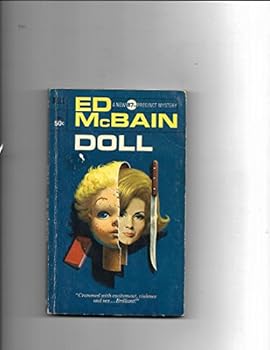
Over the weekend I decided to read a short book for my Sunday vacation. The choice was Ed McBain’s 60s novel, “Doll.”
McBain, who died in 2008, is a Grand Master celebrated by the Mystery Writers of America. He wrote over 50 books in his 87th Precinct series, which is considered by the MWA as one of the best, if not THE best, police procedural series of all time.
McBain was an excellent writer, not always something one can say about a mystery writer. His prose is clean and pure, with small dabs of poetry here and there. His characters are fully fleshed and interesting. You like them, even the villains. The dialogue is crisp and sometimes funny but always believable. And his grasp of police procedure is very good…with a glaring exception.
It is this exception which ruined the book for me. I will read more McBain but I’ll always be keeping a cocked eye out for the stumbling.
In the book, the main police detective suddenly realizes who the killer is. That’s at about page 50 of a 150-page book. We are not told how he comes to this conclusion. But we are told that he runs out to confront and arrest the killer. Alone. Without backup. Without calling his partner to say, “Hey, I know who did it!” Without leaving a note, a report, nothing about his conclusion. He just jumps in his car and drives to the killer’s house (he has the address from the victim’s address book).
When he gets there, he kicks down the door, rushes in, and his knocked unconscious by the killer coming from the left when he was looking to the right.
Now, I know that often an author needs his/her main character to be taken hostage by the bad guy. Not sure why this became a trope, but from the 40s, it often happens in a hard-boiled detective story that the main character is captured by the bad guys. In this case, it happens because the author needs to have scenes where the main detective, handcuffed and restrained, can be tempted by a buxom brunette who likes to taunt him by appearing naked in front of him. What are you gonna say? It was the 60s, when naked women liked to handcuff men and taunt them, ala James Bond.
But the problem is that this is a police procedural, not a spy novel. If you’re gonna write about police, you’re sort of handcuffed to their rules and procedures. And one of the biggest rules for cops, going back more than 100 years, is that you NEVER go to confront a suspect without some sort of backup.
It’s not explained why the detective needed to go immediately to confront the suspect. In real life, he would have, at the very least, radioed in his location and his activity, so that the precinct would know where he was. This guy didn’t. Consequently, the bad guys killed another witness and tried to make it look like the dead guy was the detective by rolling the corpse off the hill in a burning car. Again, the 60s.
I am not a cop. I was assigned as one for six months when I was in the Air Force. And, as a lawyer, I’ve talked to cops, cross-examined cops, read up on local department procedures. I know a little about this. and I immediately knew that the plot point of the cop going alone, not telling anyone where he was going, so that everyone would think he was dead, is just wrong. It would never happen in real life. Certainly not in a large metropolitan area like the one depicted in “Doll.”
This soured me on the book. There was another trope that I absolutely hate, in which the bad guys keep the main character alive after they capture him, “to find out what he knows.” That trope didn’t work in this case. I had a hard time believing that the bad guy would care what the cop knew. It would be easier just to kill him.
Still, the overall mystery was good, the writing was excellent, and I’m going to give McBain another chance. He wrote over 50 more books about this group of cops, all of which were best sellers. So maybe this was an anomaly.
So I’ll give him another chance. Not that he needs me. He’s a grand master, after all, and I’m still trying to get a publisher for my first Minerva novel. Still this one didn’t pass the Mark Bruce test, which is, If Mark Bruce had written this novel, word for word, would a publisher have accepted it?
You can answer on your own.
 Mark Bruce, Writer